Search "keto for gut health" and you'll find plenty of confident promises. Then you actually try it, and by day four you're bloated, constipated, and wondering whether you've made things worse.
That gap between the promise and the reality is the whole story of the keto diet and IBS.
The short version: keto helps some people with IBS, and makes others feel noticeably worse. Which group you land in depends heavily on your IBS subtype, how much fat you tolerate, and what you actually eat — not on how deep into ketosis you get. This guide walks through what the research genuinely shows, why keto backfires for certain people, and how to run a careful trial if you decide it's worth testing.
The Real Evidence: Does Keto Actually Help IBS?
There's one study people point to, and it's worth understanding properly before you build a diet around it.
Thirteen people with moderate-to-severe diarrhea-predominant IBS (IBS-D) completed four weeks on a very-low-carbohydrate diet — 20 g of carbohydrate per day. Every completer met the study's definition of a responder. Around 77% reported adequate symptom relief across all four weeks. Stool frequency dropped from 2.6 to 1.4 per day, and stool form shifted away from diarrhea toward normal (study).
Encouraging results. But it was a small, uncontrolled, four-week study with 17 people enrolled and 13 finishing (full details). No control group means we can't rule out placebo effect or natural symptom fluctuation. And it only looked at IBS-D.
This is why clinical IBS guidelines don't recommend keto. They point instead toward a structured, time-limited low-FODMAP trial with reintroduction, ideally guided by a dietitian (ACG Clinical Guideline).
So does keto help IBS? Sometimes. For some people. The evidence just isn't strong enough to call it a treatment.
Why Keto Can Help — But Probably Not Because of Ketones
Here's the part most articles get wrong.
When keto improves someone's IBS, the benefit likely comes from cutting fermentable carbohydrates — not from producing ketones.
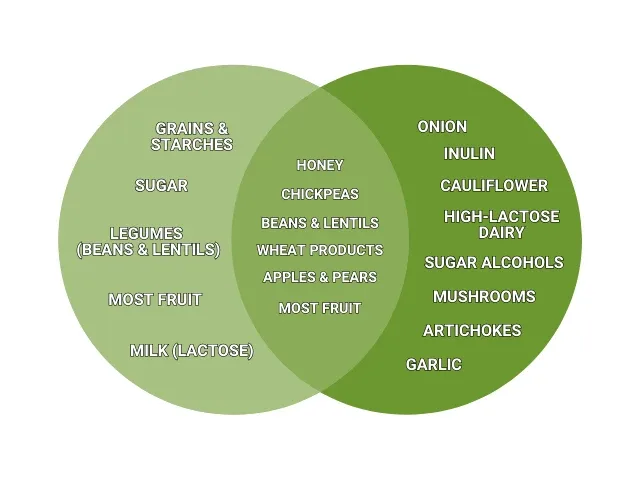
FODMAPs are short-chain carbohydrates that your small intestine absorbs poorly. They pull water into the bowel and get fermented by gut bacteria, which produces gas. In people with IBS, that combination can cause distension, pain, bloating, changes in motility, diarrhea, or constipation (research).
Because strict keto cuts out carbohydrate-heavy foods, it removes a lot of high-FODMAP foods by accident:

| FODMAP category | Common high-FODMAP foods often cut on keto | The keto catch |
|---|---|---|
| Fructans | Wheat products, onion, garlic | Onion and garlic are low-carb but still high-FODMAP |
| GOS | Beans, lentils, chickpeas | Usually avoided anyway due to carb content |
| Lactose | Milk, conventional yogurt, larger dairy servings | Keto often includes dairy, so lactose can still trigger symptoms |
| Excess fructose | Apples, pears, mangoes, honey | Mostly reduced, though some berry portions fit keto |
| Polyols | Stone fruit, mushrooms, cauliflower | Keto snacks frequently add xylitol or maltitol |
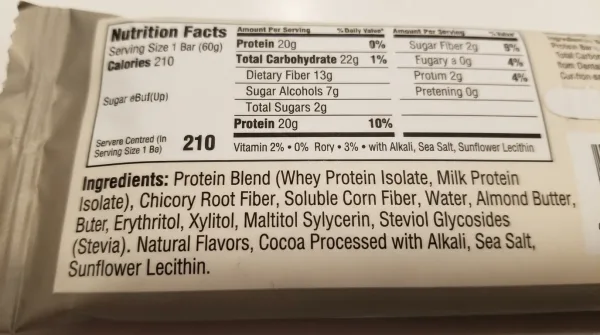
Look at that right-hand column. A keto food is not automatically an IBS-friendly food. Garlic butter, cauliflower rice, and a sugar-free protein bar are all textbook keto — and all potential triggers.
That distinction matters more than almost anything else in this article.
The Backfire Risk: How Keto Can Make IBS Worse
Plenty of people start keto and feel worse. Usually it's the composition of the diet doing it, rather than ketosis itself.
High fat can cause trouble. Larger fat intake can increase bowel urgency, loose stools, cramping, or nausea in some people. That's especially relevant if you have IBS-D — the exact subtype the research is most optimistic about.
Low fiber creates a different problem. Cutting fiber sharply, or changing it abruptly, may slow transit and worsen constipation. For IBS-C, that's a real risk.
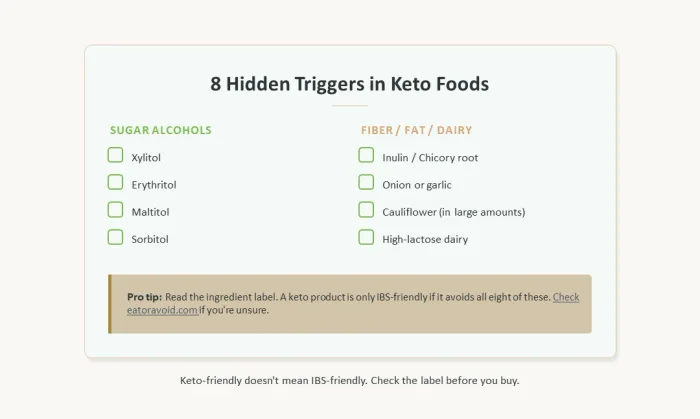
Keto substitutes are a common hidden trigger. Products marketed as keto often contain erythritol, xylitol, maltitol, inulin, or chicory root. Several of these are strongly fermentable or osmotic for people with IBS. If you're unsure what's in a product, checking the additive database before you buy is quicker than working it out after a flare.
And restriction has a cost. Staying very low-carb long-term makes it harder to get enough fiber and dietary variety, which affects both regularity and your microbiome.
On the microbiome: ketogenic diets have been fairly consistently linked to reduced Bifidobacterium, possible reductions in butyrate-producing bacteria, and lower fecal short-chain fatty acids like acetate and butyrate (review). Whether that matters for IBS specifically is unknown — very few studies have measured microbiome response to keto in IBS patients. Most data comes from non-IBS adults or animal research.
There's also a more speculative angle. Beta-hydroxybutyrate, the main ketone body, can directly suppress certain Bifidobacterium species, and in mouse and human-microbiome experiments this was associated with fewer intestinal Th17 immune cells (study). That's a plausible anti-inflammatory pathway. It's not evidence that ketones prevent IBS flares in people, and IBS isn't the same condition as inflammatory bowel disease.
Then there's keto flu, which muddies everything. Fatigue, headache, dizziness, nausea, constipation, diarrhea, and cramps are all common in the first days to weeks of carb restriction (overview). Early carb restriction lowers insulin and increases sodium and water loss through the kidneys, which can drive several of those symptoms (research).
Notice how much that list overlaps with IBS symptoms. Distinguishing an IBS flare from diet intolerance becomes genuinely difficult.
The numbers back that up. A 2026 systematic overview found gastrointestinal adverse events reported in 36 of 42 ketogenic interventions, with constipation, diarrhea, vomiting, and nausea the most common. A scoping review reported wide ranges: adult constipation 1–68%, diarrhea 2–23%, nausea 8–16% (data). Those figures aren't IBS-specific and vary a lot by study — but they're not reassuring either.
IBS-D, IBS-C, or IBS-M: Who Might Actually Benefit?
Your subtype changes the calculation considerably.
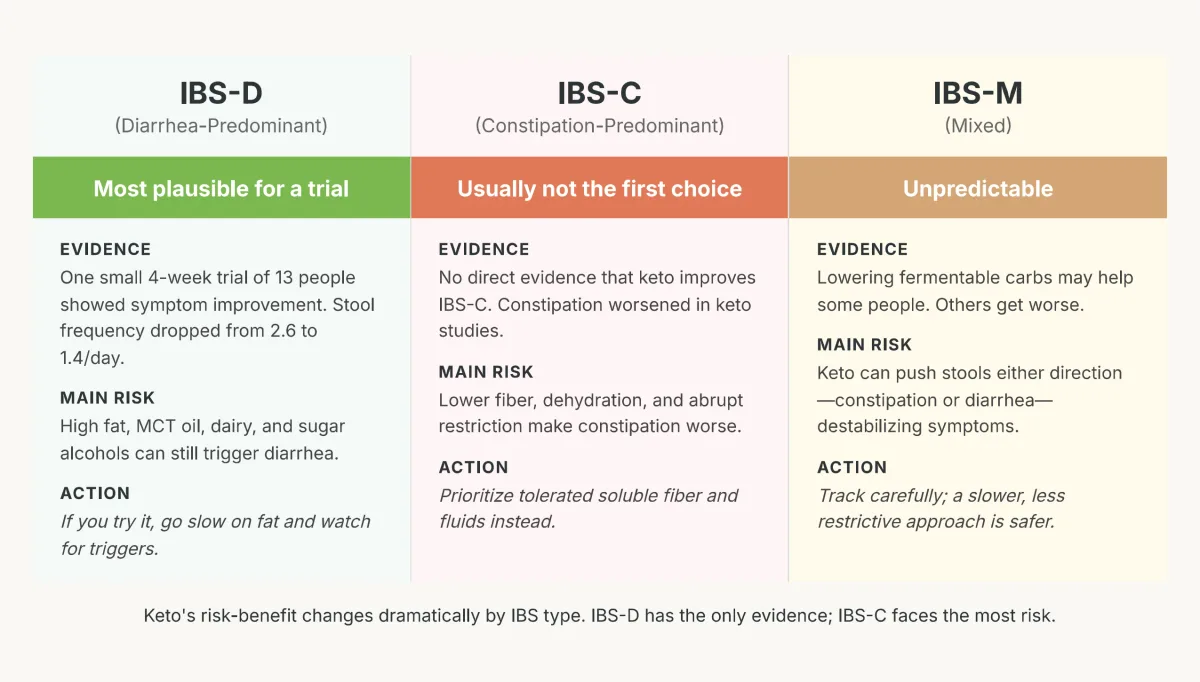
| IBS subtype | What keto might do | Main concern | What it means for you |
|---|---|---|---|
| IBS-D | The only direct trial suggesting benefit. In 13 completers, stool frequency, consistency, pain, and quality of life improved over four weeks. | High fat, MCT oil, dairy, and sweeteners can still trigger diarrhea or urgency. | The most plausible subtype for a monitored short trial — though evidence stays preliminary. |
| IBS-C | No comparable evidence that keto improves constipation-predominant IBS. | Lower fiber, dehydration, and abrupt restriction can worsen constipation. | Usually not your first choice. Prioritize tolerated soluble fiber, fluids, regular meals, and established IBS-C treatments. |
| IBS-M | Lowering fermentable carb exposure may reduce bloating or diarrhea episodes for some. | Keto can push stools toward constipation while high-fat foods trigger diarrhea — either direction can destabilize things. | A symptom diary and a slower, less restrictive trial matter a lot here. |
If you have IBS-C and someone tells you keto will fix your constipation, they're going beyond the evidence.
A Safer Way to Try Keto With IBS
If you still want to test it, the approach that makes sense is a short, gradual, symptom-tracked trial built around your subtype — not a sudden high-fat switch.
Before you start, get your symptoms properly evaluated and review the plan with a gastroenterologist or GI dietitian. This matters especially if you have diabetes, kidney disease, gallbladder or pancreatic disease, a history of eating disorder, are pregnant, or take glucose-lowering medication.
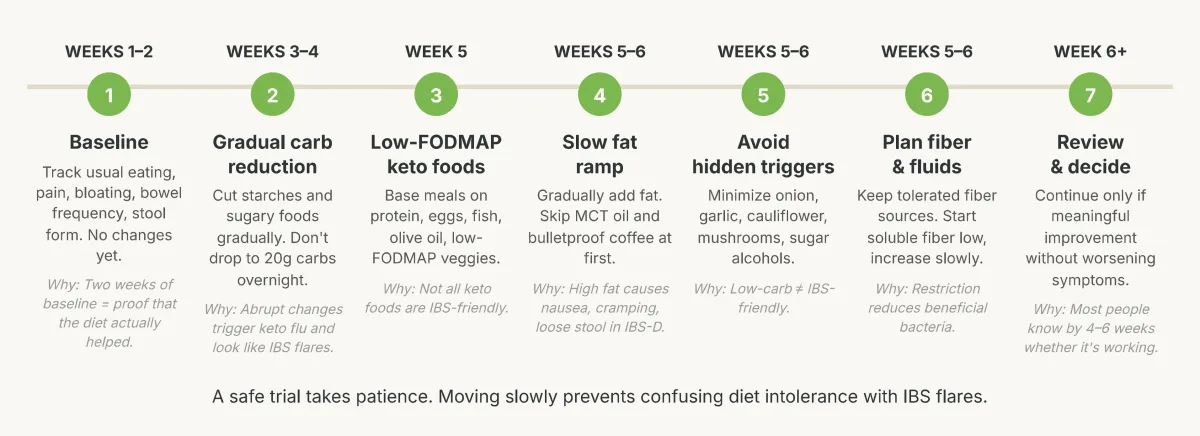
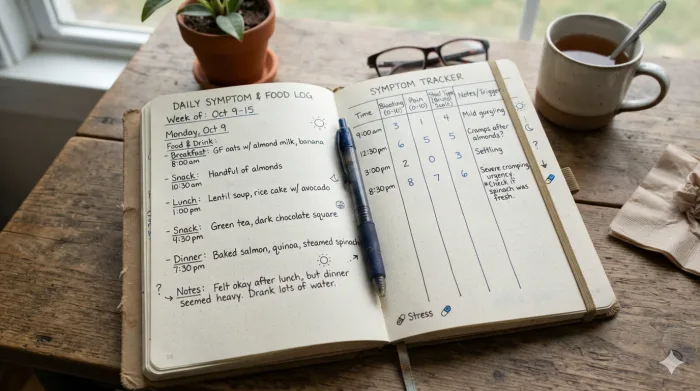
- Establish a baseline for 1–2 weeks. Keep eating normally while you record abdominal pain, bloating, urgency, bowel movement frequency, and Bristol Stool Form Scale type. Without this, you'll never know whether the diet actually helped.
- Reduce carbohydrate gradually. Rather than dropping straight to 20–30 g net carbs a day, cut starches and sugary foods over roughly one to two weeks. Abrupt shifts in fiber, fat, fluid balance, and meal composition can produce symptoms that look exactly like an IBS flare.
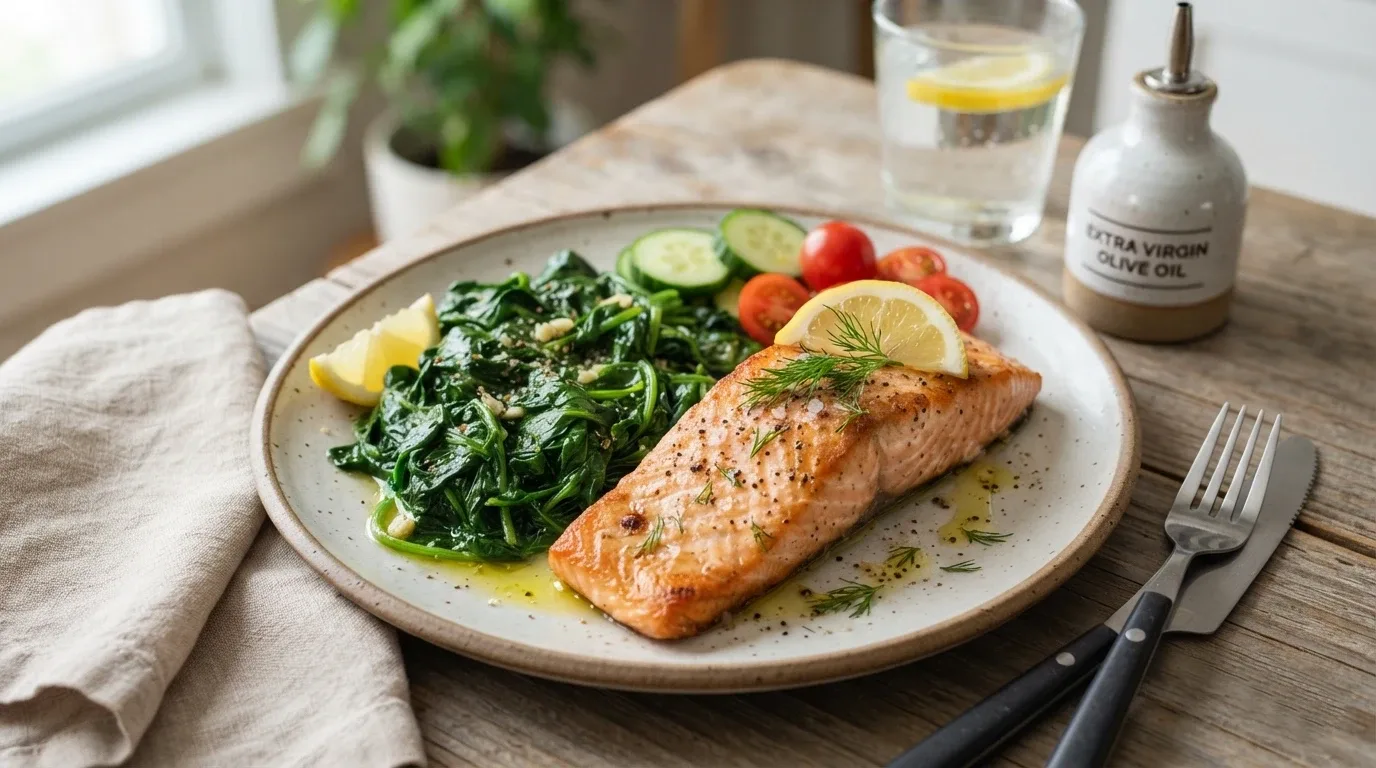
- Start with low-FODMAP keto foods. Build meals around protein, eggs, fish, tofu if you tolerate it, olive oil, small portions of nuts and seeds if tolerated, and low-FODMAP non-starchy vegetables — zucchini, spinach, cucumber, peppers, tomato, eggplant, green beans. Portion size still matters.
- Raise fat slowly. Skip the large quantities of butter, cream, fried food, bulletproof coffee, and MCT oil at the start. These can cause nausea, cramping, loose stool, and urgency, particularly with IBS-D.
- Avoid the frequent hidden triggers. In the first weeks, minimize onion, garlic, cauliflower, mushrooms, conventional milk and yogurt if you're lactose-sensitive, inulin or chicory root, and sugar alcohols. Maltitol, sorbitol, xylitol, and larger amounts of erythritol in keto snacks are common culprits.
- Plan for fiber, fluid, and regular meals. Low-carb doesn't have to mean no plants. Keep the fiber sources you tolerate. For constipation, soluble fiber is generally preferred — start low and increase slowly to limit bloating. Wheat bran and insoluble fiber aggravate symptoms in some people (BSG guideline).
- Review at 4–6 weeks. Continue only if you've seen meaningful, sustained improvement without unacceptable constipation, diarrhea, dietary burden, or nutritional compromise. If you continue, reintroduce foods methodically rather than staying highly restricted indefinitely.

This is where keto sits at the opposite end of the spectrum from something like a sattvic diet, which is built around high fiber and low fat. Neither pattern is automatically right for IBS — but if you're coming from a plant-heavy way of eating, the fiber drop on keto will be steep, and worth planning for.
One more practical note: introduce new keto products one at a time. If you add MCT oil, a sugar-free bar, and a new dairy product in the same week and your symptoms shift, you've learned nothing about which one did it.
Keto vs. Low-FODMAP: Which Should You Try First?
Major gastroenterology guidance doesn't list keto as an established IBS therapy. The emphasis sits elsewhere:
- Start with individualized traditional IBS dietary advice — regular meals, identifying your personal trigger patterns.
- Use soluble fiber, particularly where constipation is present, increasing gradually since too much too fast worsens gas and bloating (BSG guideline).
- Consider a time-limited low-FODMAP diet for ongoing symptoms, with a trained dietitian, followed by reintroduction based on tolerance. The British Society of Gastroenterology calls it an effective second-line dietary therapy, with supervision and reintroduction both specified.
- Avoid prolonged unsupervised restriction, which can reduce nutritional adequacy, food variety, and quality of life.
The American Gastroenterological Association's diet-focused IBS guidance covers individualized nutrition care, dietitian referral, soluble fiber, low-FODMAP, and gluten-free — not keto (guidance).
The practical difference comes down to precision. A structured low-FODMAP diet is designed to identify which specific FODMAP groups and serving sizes you tolerate, then bring foods back. Keto is a broad macronutrient restriction that doesn't do that. You might feel better without ever learning why — which leaves you restricted longer than necessary.
Red Flags: When to Stop
Stop the trial and contact a clinician if you develop persistent or severe diarrhea, worsening constipation despite adjustments, vomiting, marked dizziness or dehydration, or you can't maintain adequate intake.
Seek prompt evaluation — and don't assume it's IBS or keto adaptation — for any of these:
- Rectal bleeding or black, tarry stools
- Unintentional weight loss
- Fever or anemia
- Severe, constant pain
- Diarrhea that wakes you from sleep
- A new, persistent change in bowel habits
These warrant medical assessment regardless of what you're eating (NIDDK).
Where That Leaves You
Keto might help your IBS. It might also make it worse. The honest position, based on what's actually been studied, is that a short monitored trial is most defensible if you have IBS-D and notice clear carbohydrate triggers — and least defensible as an indefinite default, particularly with IBS-C.
If you take one thing from this: start the symptom diary before you change anything. Two weeks of baseline data is what turns a vague sense that something helped into information you can actually use.
And if you haven't tried a dietitian-guided low-FODMAP approach yet, that's the better-evidenced place to begin.
For more on how different eating patterns affect digestion and energy, browse our nutrition and diet section.
This article summarizes published research and clinical guidance. It isn't medical advice, and it can't account for your individual situation. Speak with a gastroenterologist or registered dietitian before making significant dietary changes, particularly if you have other health conditions or take regular medication.